


If you've been told you snore, wake up exhausted no matter how many hours you sleep, or a partner has noticed you stop breathing in the night - you've probably wondered whether you have sleep apnea.
And if you've looked into getting tested, you may have run into the same wall most Canadians do: a referral to a specialist, a wait list that stretches for months, and an overnight stay in a sleep lab that feels more like a hassle than a solution.
The result? Most people put it off but that delay carries real consequences: untreated sleep apnea is linked to high blood pressure, heart disease, stroke, and diabetes, among other serious health conditions.
The good news is that home sleep apnea testing (HSAT) has fundamentally changed this picture. Modern devices now allow Canadians to get tested for sleep apnea in their own bed, get a physician-reviewed diagnosis in as little as two business days, and start treatment weeks - or sometimes even months - earlier than the traditional lab pathway allows.
In this article, we'll walk you through how the WatchPAT One works, who it's right for, what the science says about its accuracy, and what to expect from start to finish.

Getting Tested Can Be Difficult
Getting into a sleep lab for an in-laboratory polysomnography (PSG) for a sleep apnea diagnosis can be a significant challenge. A survey published in the Canadian Respiratory Journal found that patients in Ontario waited an average of 11.6 months to start CPAP therapy after their initial referral — and some pathways stretched beyond 16 months. For people in rural and remote areas, many must travel to urban centres for testing, adding costs and delays that lead some to simply give up.
Around 5.4 million Canadian adults have been diagnosed with sleep apnea or are at high risk for it — yet an estimated 80% of people living with the condition remain undiagnosed. That gap isn't because people aren't suffering. It's largely because getting tested isn't easily accessible.
The WatchPAT is a Home Sleep Apnea Test (HSAT) designed to change that — allowing Canadians to get tested in the comfort of their own home, transforming how they get diagnosed and treated for Obstructive Sleep Apnea (OSA).
Let's explore why this innovative device is revolutionizing sleep testing across the country.
Shop the WatchPAT One Home Sleep Test →
698 sleep laboratory beds serve the entire country. At our current testing capacity, working through the backlog of high-risk patients alone would take years.
Public Health Agency of Canada — Sleep Apnea Rapid Response SurveyUntreated sleep apnea is linked to elevated blood pressure, cardiovascular disease, stroke, impaired cognitive function, and type 2 diabetes. Getting diagnosed sooner means getting treated sooner — and that difference is clinically meaningful.

Enter the WatchPAT One
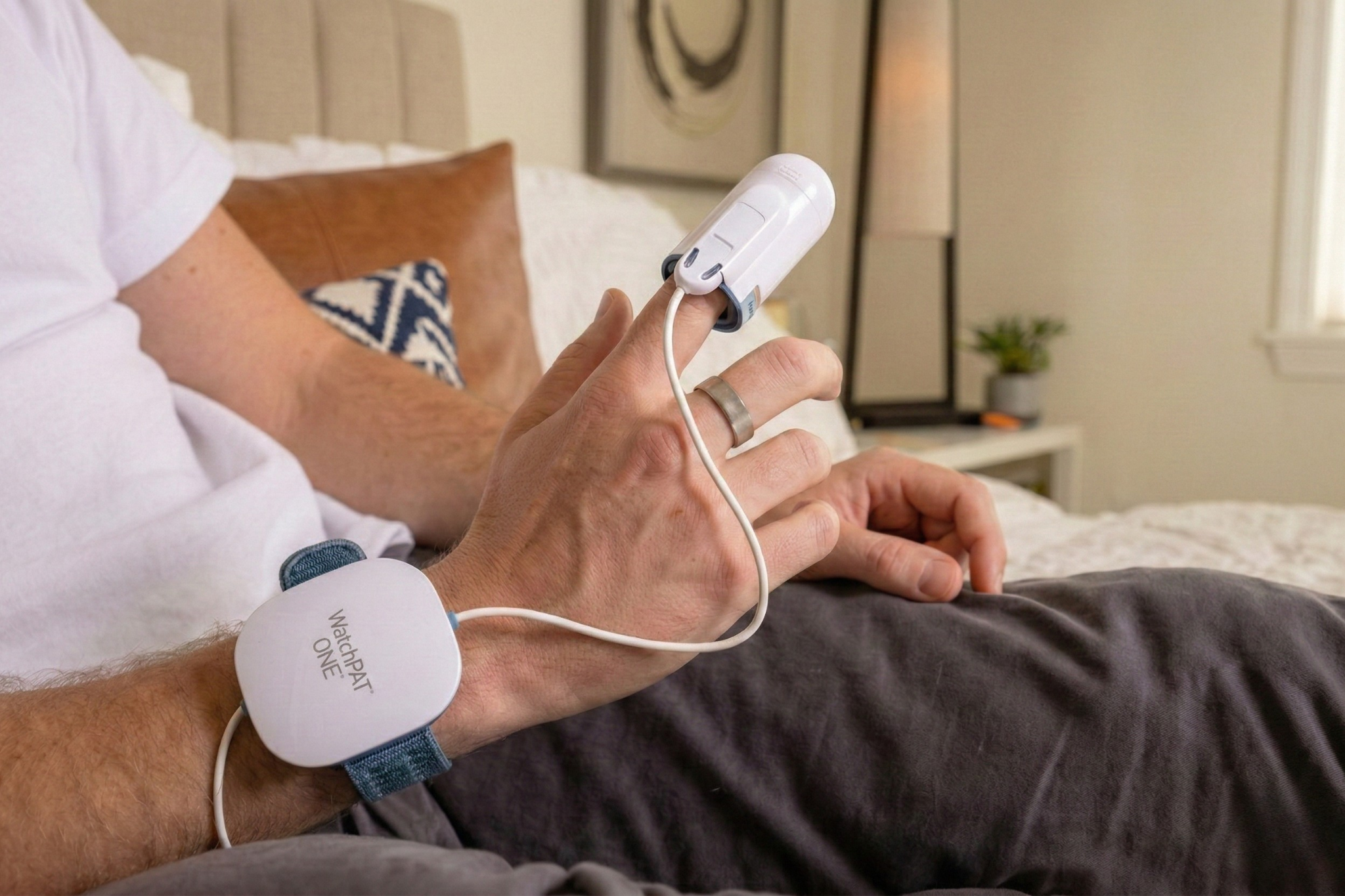
The WatchPAT One is a Health Canada-approved, disposable home sleep apnea test developed by Zoll Itamar. Instead of spending the night in a sleep lab wired to 20–30 sensors, you do the test in your own bed with just three contact points.
Measures peripheral arterial tone (PAT) and body movement to detect breathing pauses and sleep stages.
Tracks blood oxygen saturation (SpO₂) and heart rate throughout the night with precision optics.
Detects breathing effort and body position — key signals for distinguishing obstructive from central events.
A companion smartphone app walks you through setup step by step. When you wake up, your data is automatically uploaded for review by a board-certified sleep physician.
Most patients receive a full diagnosis within 2–5 business days. The device is single-use and fully disposable — no equipment to return or clean.
Shop the WatchPAT One Home Sleep Test →
Does It Actually Work? What the Science Says
WatchPAT technology uses Peripheral Arterial Tonometry (PAT) — a validated method that detects subtle changes in blood vessel tone in your fingertips when a breathing pause occurs. The American Academy of Sleep Medicine (AASM) has approved the PAT signal as an acceptable method for home sleep apnea testing.
A multicenter validation study found correlations of 0.80 or higher between WatchPAT measurements and polysomnography across multiple sleep apnea metrics. Research has also validated its use in patients with COPD and cardiac arrhythmias.
One meaningful advantage over many other home tests: WatchPAT calculates true sleep time rather than just recording time. This produces a more accurate apnea-hypopnea index (AHI) — because time spent awake is excluded from the calculation.
A 2022 meta-analysis found clinically significant discordance between WatchPAT and PSG in some patients, particularly around severity classification. Physician review of results remains essential, and some patients may still be directed toward a full in-lab study for confirmation. For the vast majority of adults with suspected uncomplicated sleep apnea, the evidence supports WatchPAT as a reliable and faster first-line tool.
Who Is It For?
WatchPAT One is well-suited for adults who:
- ✅ Experience loud snoring, gasping, or observed pauses in breathing during sleep
- ✅ Feel excessively tired despite adequate sleep time
- ✅ Wake with headaches or dry mouth regularly
- ✅ Have high blood pressure that is hard to control
- ✅ Face long wait times for a lab study or live far from a sleep centre
- ✅ Prefer sleeping in their own bed rather than a clinical environment
An in-lab study may be more appropriate if you have significant heart or lung disease, are suspected of having multiple sleep disorders, or have received an inconclusive result from a home test.
A Note for Ontario Residents
While WatchPAT One provides a legitimate sleep apnea diagnosis that can lead to CPAP treatment, Ontario's Assistive Devices Program (ADP) currently requires a Level 1 in-lab sleep study to qualify for the provincial CPAP equipment rebate (up to $415). WatchPAT One results do not meet this specific requirement.
For many people, the speed of diagnosis — and the ability to start treatment weeks or months sooner — outweighs the rebate value. Discuss with your healthcare provider to figure out which path makes the most sense for your situation.
The Timeline Difference Is Real
Here's a side-by-side comparison of what the two diagnostic paths typically look like in Canada.
Taking the Next Step
If you've been putting off getting tested because the traditional process feels overwhelming or inaccessible, WatchPAT One removes most of those barriers. The path looks like this:
 |
Shop the WatchPAT One Home Sleep Test → |
Key Takeaways — The WatchPAT One is a Health Canada-approved disposable home sleep test using three sensors: a wrist unit, finger probe, and chest sensor. It delivers a physician-reviewed diagnosis in 2–5 business days — compared to the 11–16 month pathway typical of in-lab testing in Canada. It is well-suited for adults with suspected uncomplicated OSA. Ontario residents should note that WatchPAT results do not currently qualify for the ADP CPAP equipment rebate.
Sources
- Evans J, et al. Sleep laboratory test referrals in Canada. Canadian Respiratory Journal. 2014;21(1):e4–e10.
- Pendharkar SR, et al. Temporal trends in OSA. Annals of the American Thoracic Society. 2023.
- Rotenberg BW, et al. Wait times for sleep apnea care in Ontario. Canadian Respiratory Journal. 2010;17(4):170–174.
- Povitz M, et al. Clinical pathways for OSA care in Ontario. Can J Resp Crit Care Sleep Med. 2019;3(2):91–99.
- Pendharkar SR, et al. Testing and treatment for OSA in Canada. CMAJ. 2017;189(49):E1524–E1528.
- Schwartz A, et al. COMPASS study: validated scoring for PAT-based technologies. J Clin Sleep Med. 2020.
- Schwartz AR, et al. Detecting central sleep apnea using WatchPAT. Sleep and Breathing. 2020.
- Jen R, et al. Accuracy of WatchPAT in COPD. COPD. 2020;17(1):34–39.
- Iftikhar IH, et al. Meta-analysis of PAT diagnostic performance. J Clin Sleep Med. 2022;18(4):1093–1102.
- Plante DT, Rumble ME. Don't hold PAT. J Clin Sleep Med. 2023;19(12):2113–2116.
- Ontario Assistive Devices Program CPAP rebate requirements.